
I’m in deep.
As an investor in Reviva Pharmaceuticals (OTC: RVPH), I follow the company and its scientific progress very closely. So imagine my surprise when my research on Reviva’s patents stirred up something I consider very important — something that, as far as I can tell, hasn’t yet been meaningfully discussed or analyzed.
There is a monster lurking around Reviva……. Teva Pharmaceuticals.
Teva’s New Direction
Teva has long been known as one of the world’s largest generic-drug manufacturers. But under its Pivot to Growth strategy, the company is building a broader biopharmaceutical business, with innovative medicines and neuroscience — including psychiatric drugs — as important growth drivers.
Teva already operates directly in schizophrenia through UZEDY, has other CNS drugs, and possesses enormous development, manufacturing, medical and commercial infrastructure. They are the definition of Big Pharma.
And I recently discovered that Teva has spent considerable scientific effort studying Brilaroxazine itself — and remains actively engaged in patent work around it.
Teva’s Deep-Dive Into Brilaroxazine
Through Assia Chemical Industries, part of Teva’s API business, Teva scientists conducted a substantial solid-state development program around Brilaroxazine. You can see the patents generated by this work by searching “Assia” and “Brilaroxazine” at Google Patents. But stay with me for a bit first.
Teva / Assia has conducted comparable solid-state and patent work on dozens of drugs developed by other companies. So that by itself, is not unusual. Investigating compounds is part of what Teva’s API operation does.
What caught my attention was the depth of the work on Brilaroxazine. Teva researchers produced numerous crystalline forms of Brilaroxazine and its salts, developed different methods of making them, and studied how selected forms behaved under heat, humidity, grinding, compression and different solvents.
Simply put, they conducted extensive research on Brilaroxazine and built relatively broad patent coverage around specific crystalline and salt forms.
In practical terms, they were asking the kinds of questions that matter in pharmaceutical development: What forms can this molecule take? Which are stable? Can they be produced reliably? Can they withstand manufacturing conditions? Could particular forms ultimately be useful in a commercial pharmaceutical product?
Teva has not merely “looked at” Brilaroxazine. It has conducted substantial hands-on scientific and intellectual-property work around the molecule, with patent filings continuing in several major markets.
That is a real signal of commercial relevance. What kind of commercial interest it represents is the unanswered question.
Teva’s Timing
The timing makes this considerably more interesting. The earliest Teva / Assia priority filing dates to January 2023, while Reviva did not announce the successful results from its RECOVER Phase 3 schizophrenia trial until October 2023.
Because the underlying laboratory work necessarily preceded the patent filing, Teva’s investigation began before Brilaroxazine had achieved Phase 3 validation. In other words, somebody inside Teva had already concluded that Brilaroxazine was worth investing scientific resources and intellectual-property capital into before RECOVER succeeded.
This becomes more meaningful when viewed against Assia’s broader patent history. Teva has performed similar work on compounds including lumateperone, mavacamten, ensifentrine, nirogacestat, belumosudil and others. Many later became commercially important drugs or highly valuable pharmaceutical assets. In several cases, their developers were eventually acquired by major pharmaceutical companies including J&J, Bristol Myers Squibb, Merck and Sanofi. And many failed, or stalled.
Importantly, Teva did not acquire most of them, and that distinction matters. Teva’s solid-state patent work should not be interpreted as a hidden M&A announcement. The more conventional explanation is that Teva uses this capability to build technical knowledge and commercial optionality around molecules that may eventually matter for manufacturing, supply, licensing, generic competition, partnership — or occasionally acquisition.
But Brilaroxazine now sits at an interesting intersection. It fits naturally within Teva’s longstanding API and pharmaceutical-development expertise, while also being a late-stage schizophrenia drug in precisely the therapeutic area where Teva is now building its innovative neuroscience franchise.
The Signal In The Noise
This led me to a narrower question:
What happened to other third-party compounds that 1) Assia studied / developed patents around and 2) subsequently achieved at least 1 successful Phase 3 trial? Because this is where Brilaroxazine now stands.
Research identified 18 compounds that fit this definition (Not including Brilaroxazine). And the outcomes are striking.
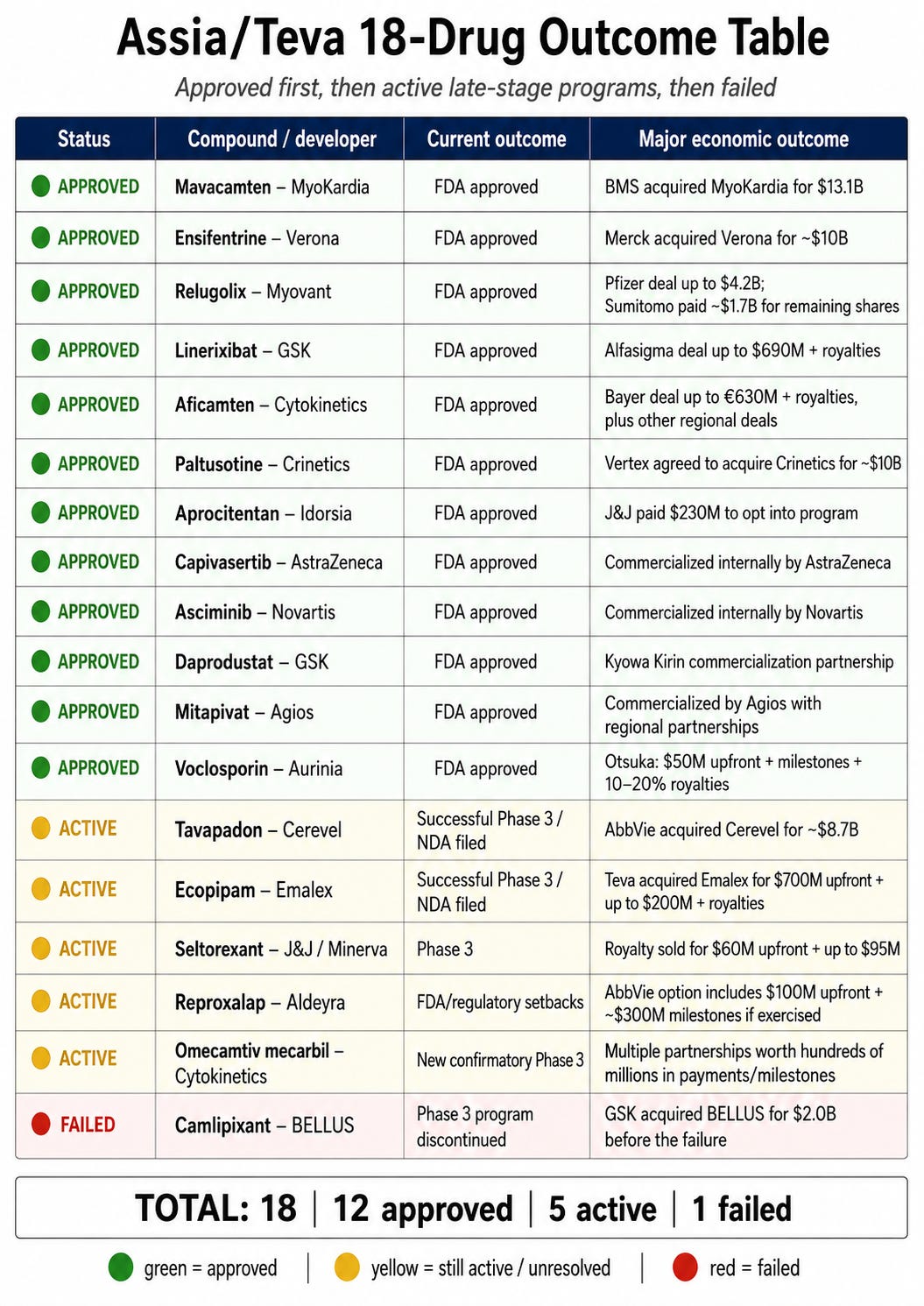
The outcome pattern is hard to ignore. Of the 18 compounds Assia / Teva selected for this type of solid-state work, 12 are already FDA-approved, 5 remain active in late-stage development, and only 1 has clearly failed.
Several of the companies behind those drugs were later acquired in major transactions, including MyoKardia for $13.1B, Verona for about $10B, Crinetics for about $10B, Cerevel for $8.7B, BELLUS for $2B, and Emalex for $700M upfront plus milestones and royalties. Other compounds generated substantial licensing, royalty and commercialization agreements.
The takeaway is clear: Once an Assia-investigated compound reaches successful Phase 3 validation, the historical commercial outcomes have been overwhelmingly positive.
Brilaroxazine has now entered that group. And among those 18 comparables, one example in particular deserves a closer look: Emalex Biosciences. I’ll come back to that.
Yet More Intrigue
There is another piece of the story. Reviva disclosed that an unnamed third party filed a U.S. patent application claiming a form of Brilaroxazine, prompting Reviva to initiate a derivation proceeding before the U.S. Patent Trial and Appeal Board — the PTAB — arguing that the disputed invention originated with Reviva and was filed without authorization.
Teva’s independent work on Brilaroxazine naturally raises an obvious question: Is Teva/Assia the unnamed third party?
There is currently no public evidence establishing that connection. But consider the facts: 1) Teva/Assia has a visible international patent family involving forms of Brilaroxazine, 2) It is the only significant third-party patent family involving Brilaroxazine forms that I have been able to identify, and 3) The timing and subject matter also appear consistent.
If it walks like a duck and quacks like a duck…
Still, until the identity of the third party becomes public, this remains an inference, not a fact. Either way, the important point remains: Brilaroxazine has attracted enough outside intellectual-property activity that Reviva is actively defending its position before commercialization.
Speaking of Defense…
At virtually the same time, Reviva has taken a major IP step of its own. The company filed a new composition-of-matter patent application covering a new form of Brilaroxazine, which Reviva believes could potentially extend patent protection to approximately 2046.
This matters enormously because the relatively short remaining life of Reviva’s original Brilaroxazine patents has been one of the asset’s biggest commercial weaknesses. A pharmaceutical company is far more likely to invest heavily in schizophrenia — and then pursue additional indications such as bipolar disorder or depression — if it has a long period of exclusivity in which to earn a return.
Reviva therefore intends, subject to FDA agreement, to use the new form in RECOVER-2 and carry it through the NDA and into eventual commercialization. So while Teva has been building an IP position around forms of Brilaroxazine, Reviva is simultaneously attempting to strengthen and extend its own control over the molecule.
And somewhere in the middle sits the PTAB proceeding. VERY Interesting.
So What Is Teva Up To?
Now we get to Emalex.
As part of its ‘Pivot to Growth’ strategy, Teva has begun buying innovative neuroscience assets. Most recently, it acquired Emalex Biosciences for $700 million upfront, plus up to $200 million in commercial milestone payments and royalties, to gain ecopipam, an unapproved CNS drug being developed for Tourette syndrome.
What makes that transaction particularly interesting to me is that a few years before Teva acquired Emalex, Teva’s Assia unit had already conducted solid-state work on ecopipam and filed patents around the molecule.
The sequence is remarkably familiar. Ecopipam produced positive Phase 2 data, attracted Assia solid-state investigation and patent work, subsequently succeeded in Phase 3, and a few years later the company behind it was acquired by Teva.
Brilaroxazine has now followed that same path: positive Phase 2 data, Assia solid-state investigation and patent work before pivotal validation, and then a successful Phase 3 trial.
That does not mean Reviva is the next Emalex. Among the 18 comparable compounds I identified, Emalex is the only developer Teva itself ultimately acquired. Most successful Assia-investigated drugs were acquired by somebody else or commercialized by their existing owners.
But Emalex establishes something important: There is at least one recent precedent in which Teva studied and patented an externally owned CNS compound before ultimately acquiring the company behind it at a late stage of development. And that was recent, under Teva’s new strategy. That makes thier work hard to dismiss as meaningless.
So Where Does This Leave Us?
None of this establishes that Teva intends to acquire Reviva. But it does establish several things I did not appreciate before undertaking this research.
Teva has devoted meaningful scientific and intellectual-property resources to Brilaroxazine.
Other compounds with similar Teva histories have overwhelmingly become commercially meaningful pharmaceutical assets.
Teva itself has now acquired a comparable CNS developer after following a surprisingly similar sequence with its drug.
And Teva continues to build out its novel CNS drug portfolio.
And today, while Teva continues building patent positions around Brilaroxazine forms, Reviva is simultaneously defending its IP through the PTAB and attempting to extend its own composition-of-matter protection potentially into the 2040s.
The evidence does not tell us what Teva ultimately intends to do. But it does tell us that Teva’s interest in and investigation of Brilaroxazine is real.
Which leaves one very large unanswered question:
What does Teva ultimately intend to do with the scientific knowledge and intellectual property it has created around Brilaroxazine?
A monster in the deep indeed.